
Before I start describing and later on testing the Nanoxia Deep Silence 120 mm – 1.800 U/min I believe it will be nice to pay some attention to the whole Nanoxia Deep Silence series first, which offers a huge variety by size and rotating speed models separated in two different categories:
Nanoxia Deep Silence models:
- Deep Silence 60 mm – rotating at maximum 2000 revolutions per minute with airflow level of 15.8 CFM and noise level of 12.1 dB(A).
- Deep Silence 80 mm – rotating at maximum 1200 revolutions per minute with airflow level of 15.8 CFM and noise level of 13,6 dB(A).
- Deep Silence 92 mm – rotating at maximum 1400 revolutions per minute with airflow level of 23.6 CFM and noise level of 13,7 dB(A).
- Deep Silence 120 mm – rotating at maximum 1000 revolutions per minute with airflow level of 55.4 CFM and noise level of 12.8 dB(A).
- Deep Silence 120 mm – rotating at maximum 1300 revolutions per minute with airflow level of 60.1 CFM and noise level of 14.2 dB(A).
- Deep Silence 120 mm – rotating at maximum 1800 revolutions per minute with airflow level of 72.1 CFM and noise level of 19.9 dB(A).
- Deep Silence 140 mm – rotating at maximum 1100 revolutions per minute with airflow level of 68.5 CFM and noise level of 14.4 dB(A).
- Deep Silence 140 mm – rotating at maximum 1400 revolutions per minute with airflow level of 76.5 CFM and noise level of 16.2 dB(A).
- Deep Silence 140 mm – rotating at maximum 1800 revolutions per minute with airflow level of 98.3 CFM and noise level of 20.8 dB(A).
Nanoxia Deep Silence PWM models:
- Deep Silence 92 mm PWM – rotating 400-1400(+/- 10%) revolutions per minute range with maximum airflow level of 40,1 m³ and noise level of 13.7 dB(A).
- Deep Silence 120 mm PWM – rotating 650-1500(+/- 10%) revolutions per minute range with maximum airflow level of 114.3 m³ and noise level of 16.9 dB(A).
- Deep Silence 140 mm PWM – rotating 700-1400(+/- 10%) revolutions per minute range with maximum airflow level of 76,5 CFM and noise level of 16.2 dB(A).
After I wrote the lines above I was like WOW. I hadn’t realized before they have so many models in the portfolio, which actually is very good since they provide a huge variety of products for all kind of needs. Anyway, for this test and review I am going to check what Nanoxia Deep Silence 120 mm – 1.800 U/min has to offer and how it performs.

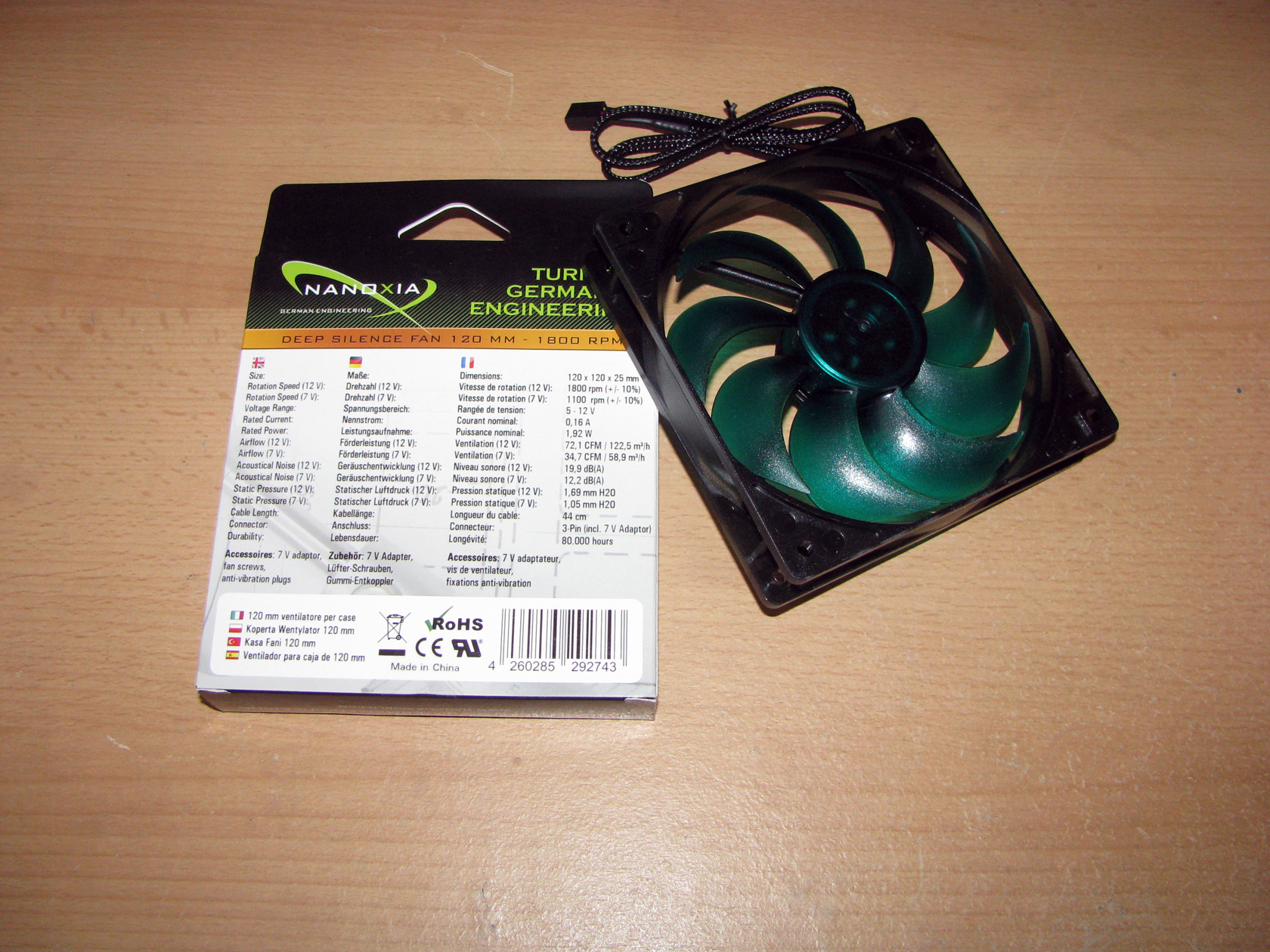
Nanoxia Deep Silence 120 mm – 1.800 U/min was provided to me in a pretty standard package made of a carton painted in white, black, yellow and green with some technical details regarding the product and a huge see-through cut on the front panel, through which we can see the propeller structure. And here is something which made me smile – the title on the right part of the front panel – TURN ON GERMAN ENGINEERING. Very nice and the pure truth. So far I’ve tested some fans from other brands designed in Germany and all of them performed really well.

Of course, the full technical details of the product are described on the back of the package in several languages. After the first look at the technical details it seems that the fan has to offer a serious performance but whether this is so, we will find out a bit later.
Now let’s check out the fan structure.
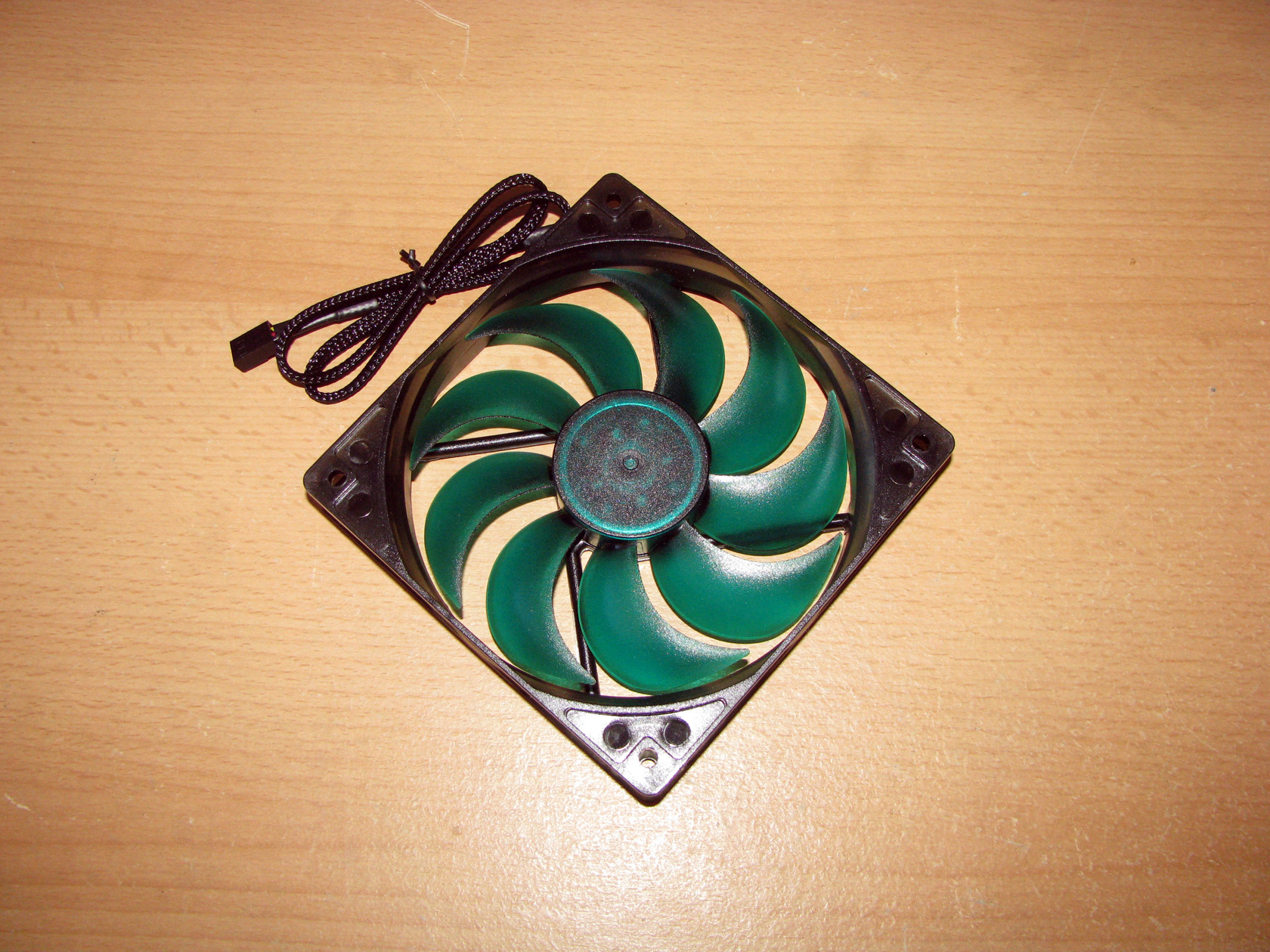
After I took the fan out of the package I noticed that it offers pretty standard structure made of a painted in black semi-transparent square frame with dimensions of 120 x 120 x 25 mm. The frame itself offers 4 holes on each side to be used when installing the model using screws or rubber dumpers on a 120mm case fan slot or on a CPU cooler heatsink.
So far so good. The frame itself looks pretty simple but I believe the propeller has something interesting to offer. In fact the propeller is made of a semi-transparent plastic painted in dark green with 9 not very wide but still very aggressively angled blades, which according to the tests I did in the past is entirely made to provide maximum airflow with maximum static pressure levels, unfortunately sacrificing the noise level.

The connection between the frame and the propeller is done by bearing working at 5-12V voltage range, which should provide stable work at up to 80.000h and is powered and regulated by a 440mm 3- pin cable sleeved in black mesh and a connector.
Now let’s check out the additional accessories provided with the fan.
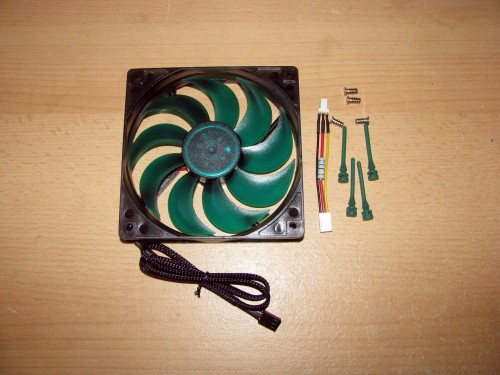
The standard package for this product offers:
- 4 metal screws
- 4 rubber dumpers
- a 7 volt adapter cable
I believe the moment to check out how the fan performs has arrived.
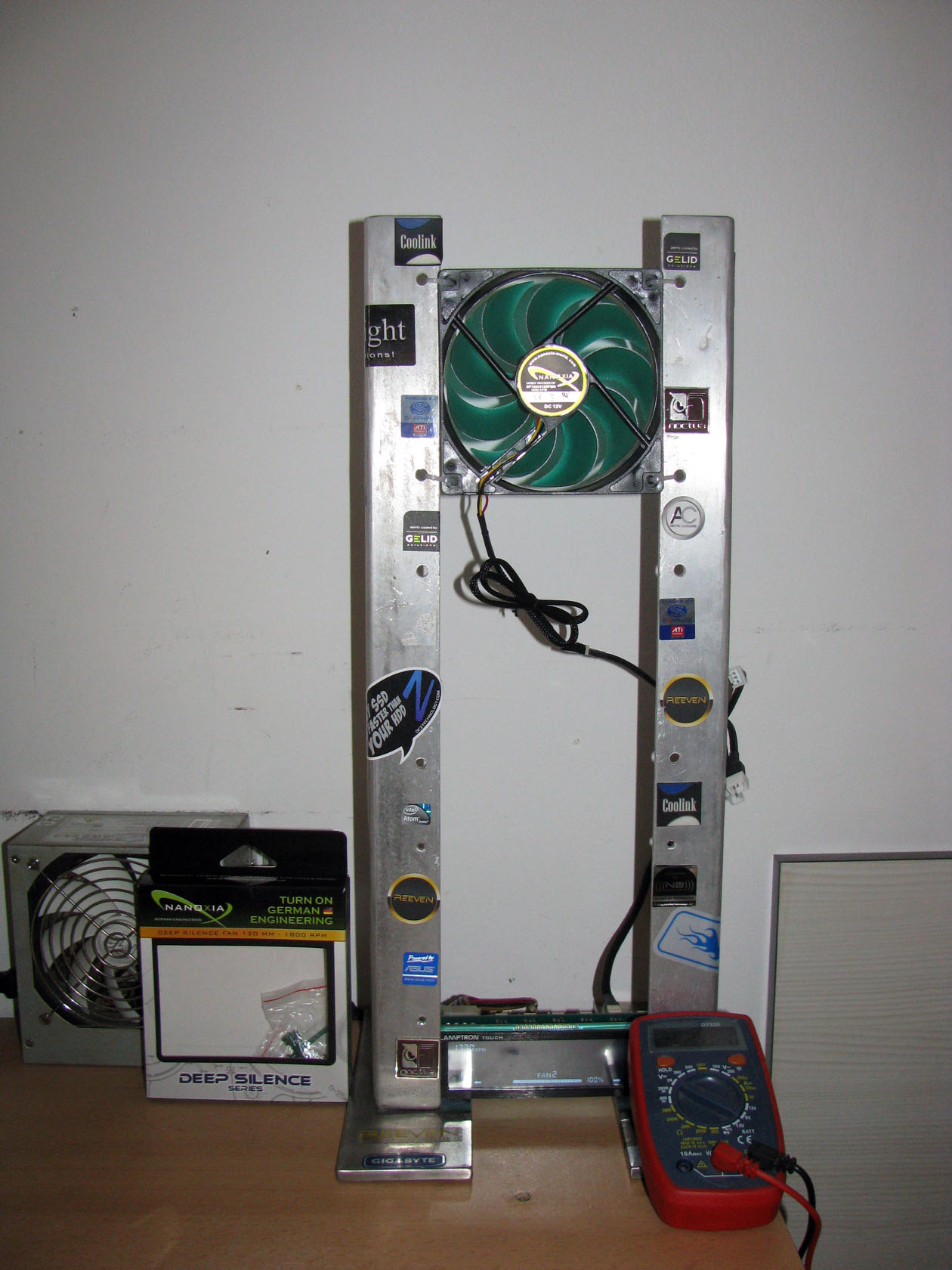
The tests will be conducted in my standard way. I will mount the fan and test it at 5V/7V/9V/12V and my goal will be to check the performance of the fan in real conditions. The product will be tested under close-to-perfect conditions, not taking into account any external factors. The results achieved during the test can in no way be the same if the fan is mounted on a cooler or on the case fan hole of any modern computer case. I will measure the amount of air going through the fan for one hour and its speed. For this I use a fan controller, a voltage meter, an anemometer and a stand made specifically for this purpose.
And this is what the fan looks like installed on my test stand:
The test results are shown in the following charts:
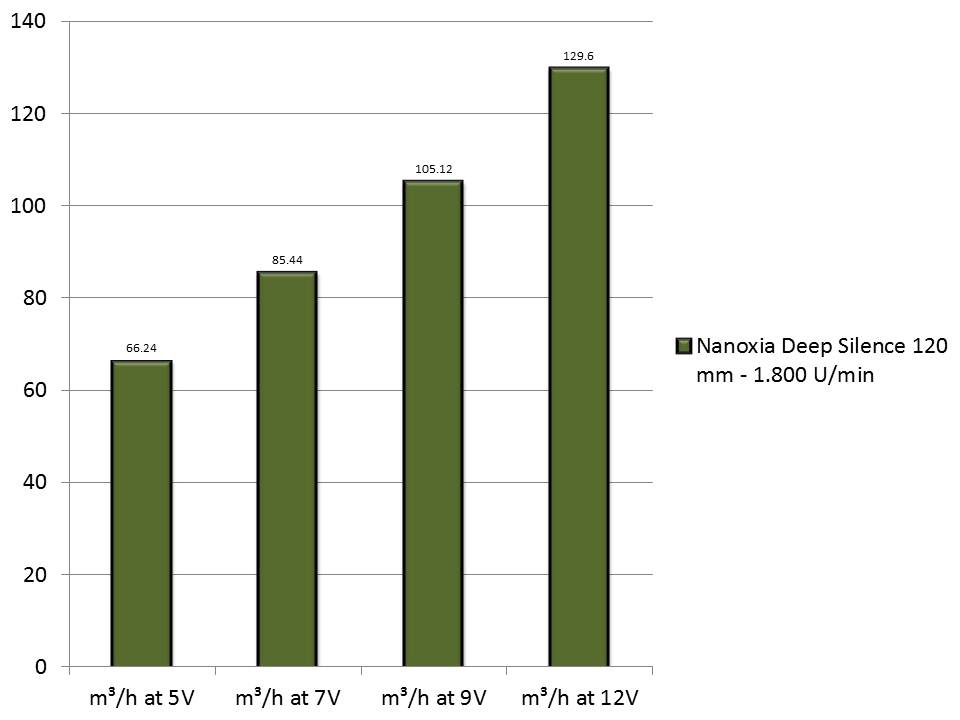
Airflow through the fan at 5V, 7V, 9V, 12V
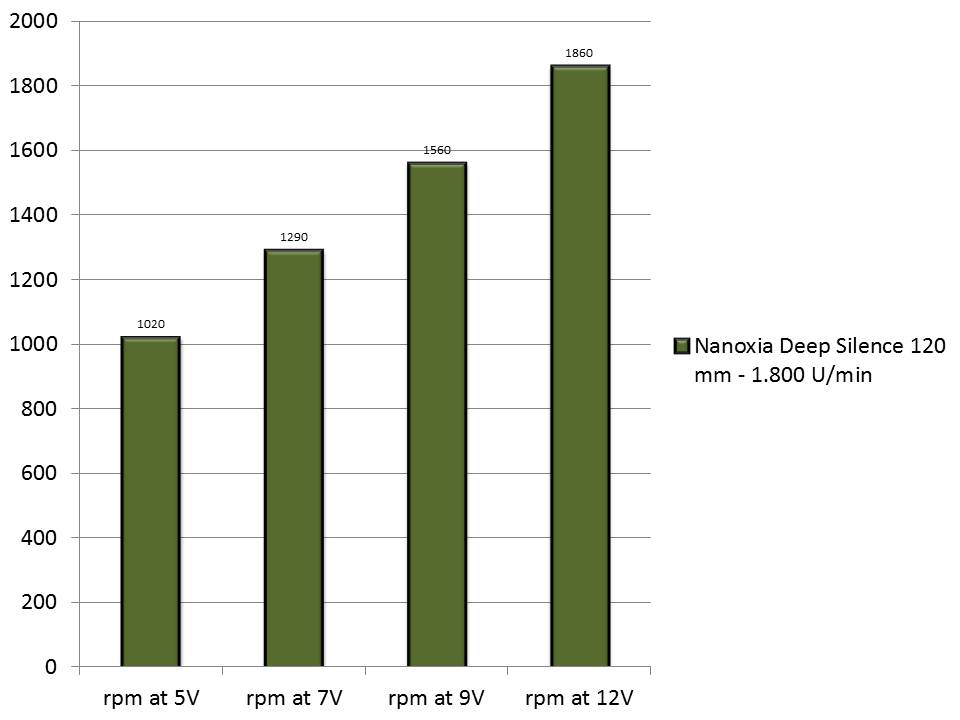
Propeller rpm during the tests at 5V, 7V, 9V, 12V.
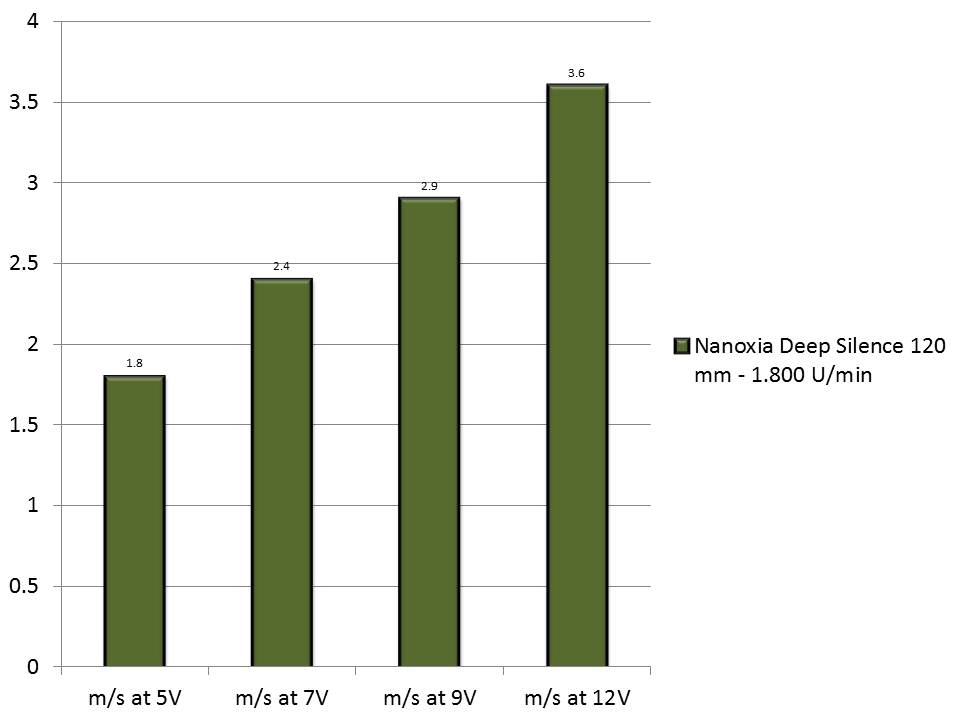
The anemometer showed the following air speed:
After mounting the fan onto the stand, and leaving it to run for about 30 minutes at maximum speed, it was time for the tests to begin.
As with my other tests, again I started with a gradual increase of the voltage through the Lamptron FCT starting at 0V and Nanoxia Deep Silence 120 mm – 1.800 U/min made at least one full revolution at exactly 5V.
Test at 5V:
At the first test conducted at 5V, Nanoxia Deep Silence 120 mm – 1.800 U/min was rotating at 1020 revolution per minute with airflow level of 66.24 cubic metres per hour and it was completely silent. In fact it was really nice to see the fan starting to operate at such high revolutions per minute with such a nice airflow level.
Test at 7V:
The second test, conducted at 7V made the fan rotate at 1290 revolutions per minute, which was just a little bit of rotation boost, but still the model was providing airflow level of 85.44 cubic metres per hour. Again the fan was completely silent, which was strange since usually the 120mm fans start getting some noise from the air passing through the propeller at about 1200 revolutions per minute..
Test at 9V:
At the third test conducted at 9V the model reached maximum airflow level of 105.12 cubic metres per hour, while operating at 1560 revolutions per minute. Unfortunately, the model wasn’t silent anymore and there was a noise coming out from the air passing through the blades.
Test at 12V:
At the final test conducted at 12V the model reached its maximum performance of 129.6 cubic metres per hour, rotating at 1860 revolutions per minute. At this speed the fan was pretty noisy but what should we expect? There was serious airflow made by a propeller rotating at serious revolutions per minute level.
I believe it is time to share my conclusions:
Performance:
According to my experience with models which I’ve tested in the past with similar propeller design, all of them were performing very well providing huge airflow and static pressure, but all of them were a bit noisy. After I finished the tests I can say we have here the same situation. At the first and the second tests the fan was completely silent with some decent airflow, but at the tests conducted at the higher voltage it got a bit noisy, of course the performance significantly increased.
After I finished the tests I can say that this model is one really well-performing product, which can be used as a case fan to boost the airflow inside the case and as a CPU heatsink cooling unit for cooling a processor working at default or overclocked frequencies. It will definitely handle it.
Appearance:
Well, what can I say… Green is not really one of my favourite colours for a PC part and still somehow this one looks very attractive. Apart from that, the overall appearance of the fan is really aggressive looking with the very sharp-angled blades of the propeller. I believe the best scenario for the black/green models is a black case supplied with fans in the same green/black colour scheme and it will definitely look very very well.
I think Nanoxia Deep Silence 120 mm – 1.800 U/min deserves the following reward:
 |
Nanoxia Deep Silence 120 mm – 1.800 U/min has been added to the 120mm fans catalogue.
Official price (MSRP): Nanoxia Deep Silence 120 mm – 1.800 U/min – unknown
Warranty: 24 months
I thank Nanoxia for the test sample.


Thanks for the nice words.
I am glad that the reviews are helping.
Great job on keeping your reviews light to read while maintaining full and detailed reviews. Its actually fun to read trough the review to
see your conclusion.
The question is.. how many enthusiasts would prefer it instead of a similar high performer and why.. (i.e. it looks good, but what makes it excel)
Another great and detailed review 🙂 This fan really has a nice and maybe little extravagant (because of the green color) look, but proves to have a very nice performance (even not being completely quiet).