As you probably know the LEPA is actually a second brand of Enermax offering very similar but still a bit different fans organized in four different series with dimensions of 120mm and 140mm:
- LEPA Chopper – LEPA Chopper 120mm review
- LEPA Casino 4C – LEPA Casino 4 Color 120mm
- LEPA Casino – LEPA Spiral 120mm review
- LEPA Vortex
- LEPA 70D series
I already did tests and reviews for a few models from the Chopper and Casino series and now is the time to test and review the test samples from the Vortex and 70D Series. For this test and review I will have some fun with LEPA Vortex LPVX12P and LEPA 70D LP70D12R.

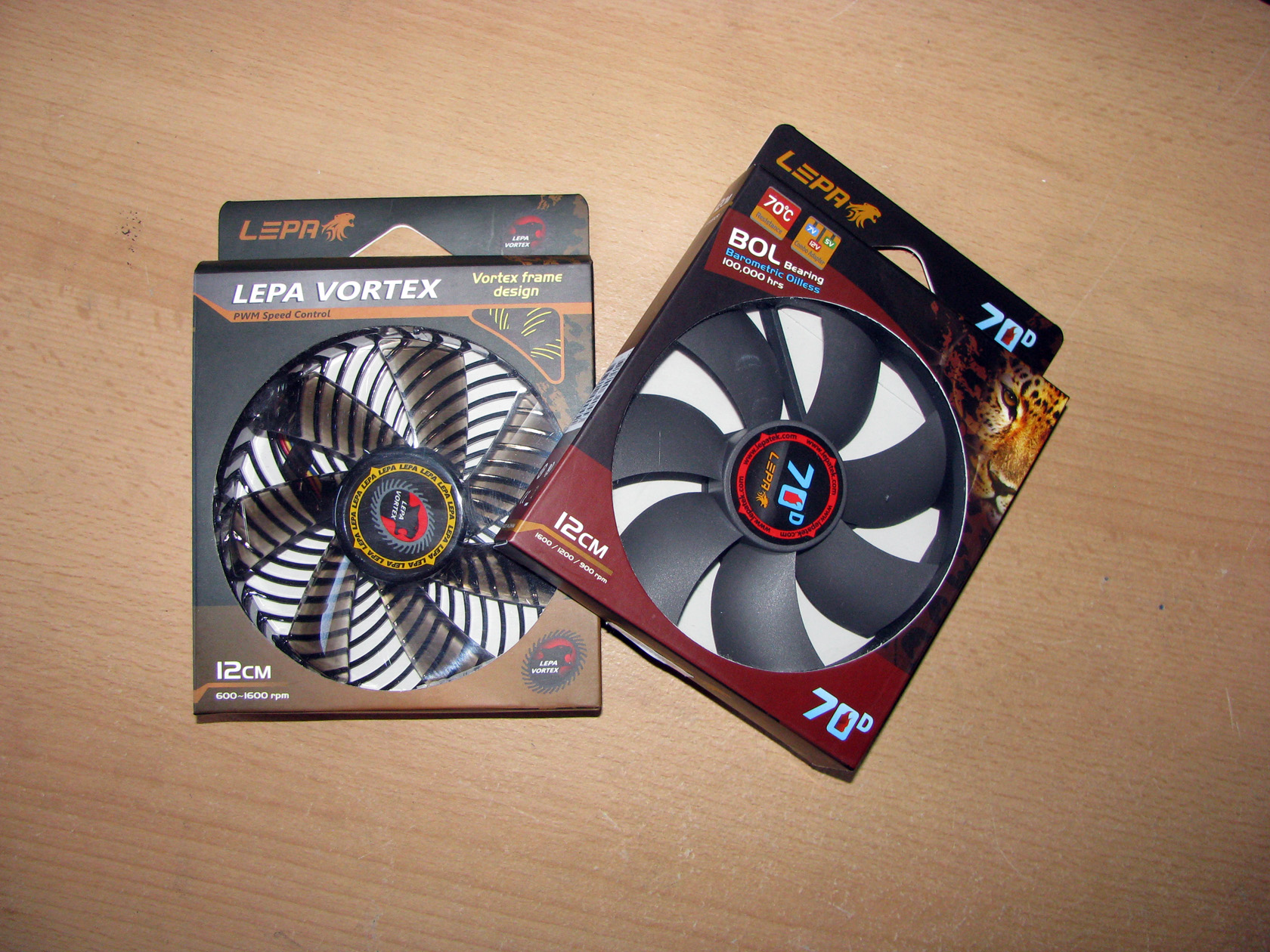
Both of the fans arrived to me in pretty much standard for the company packages made of carton box with a see through cut on the front panel, through which we can see the propeller shape of the fans, and a carton part covering the accessories. Of course there is plenty of information regarding both of the fans placed everywhere on the boxes including technical details and pictures of the products. Even though the packages are almost the same, the fans are completely different.
LEPA Vortex LPVX12P

After I removed the fan out of its package I noticed that actually LPVX12P looks very similar to the Casino series according to the shape of the frame and the propeller too, but still the fan is slightly different. Now let’s check the fan itself.

LEPA Vortex LPVX12P offers an aggresive with lots of sharp edges semi-transparent black frame made of plastic, including the channeling (V0rtex effect) on the back side and that is actually a standard feature of the Vortex and Casino series. There is one more thing I want to meantion here is that the vortex back of the frame is seen in a few models branded with the name of another company. That is really interesting!
Apart from that the model is supplied with a transparent black propeller with 7 blades with average wide surface and not very sharp angle, made to provide a big airflow level and static pressure, while operationg at low noise level. Whether that is true, we will find out a bit later.
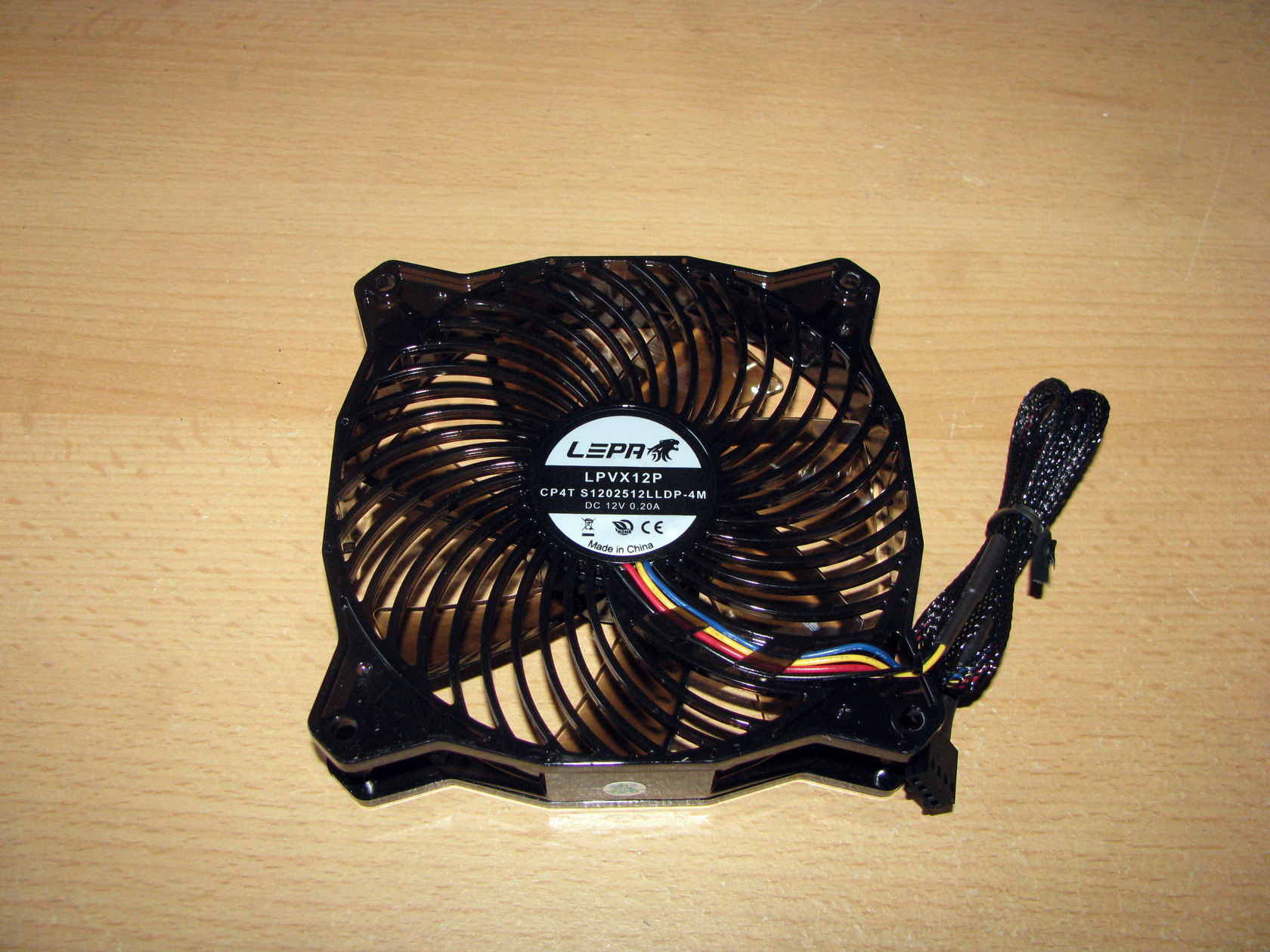
The power and regulation of the model is done by a long 4-pin PWM as usual sleeved in black cable and according to the technical details announced on the official web page the model works at 600 ~ 1600 (±10%) revolutions per minute, providing airflow level of 42.25 ~ 108.65 cubic metres per hour, static pressure of 0.66 ~ 2.18mm-H2O at only 15 ~ 25dBA.
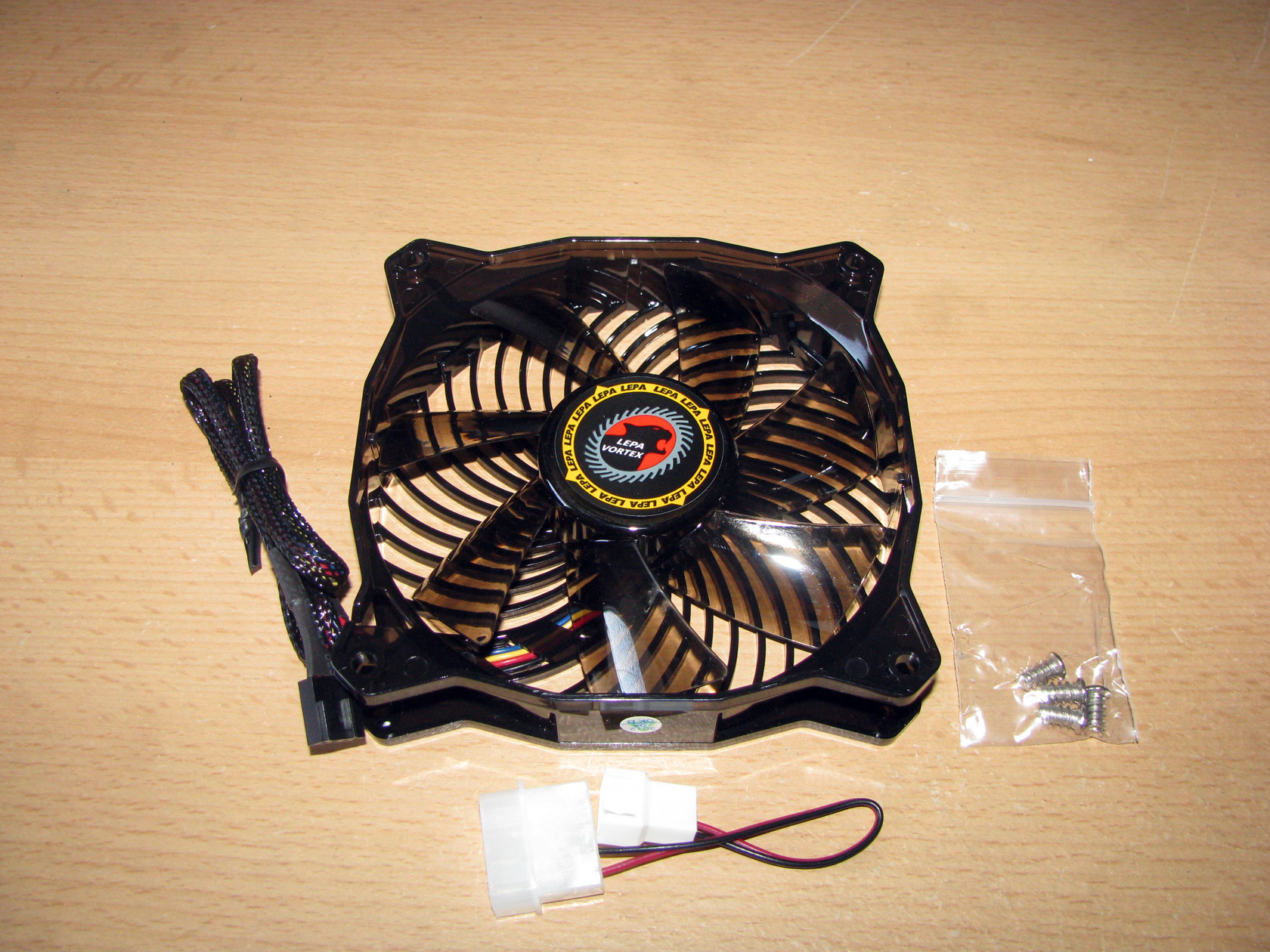
The standard package includes:
- Four screws
- 4-to-4 PWM Pin power adaptor
Not much of a package content but still it is enough so the fan can be mounted inside every new or old case offering 120mm fan slots.
LEPA 70D LP70D12R
70D series is actually something new for me, since so far I’ve tested only products from the other 4 series and actually there are 3 models included in the 70D series – a 80, 92 and 120mm. Obviously, in this article I will deal with the 120mm version.
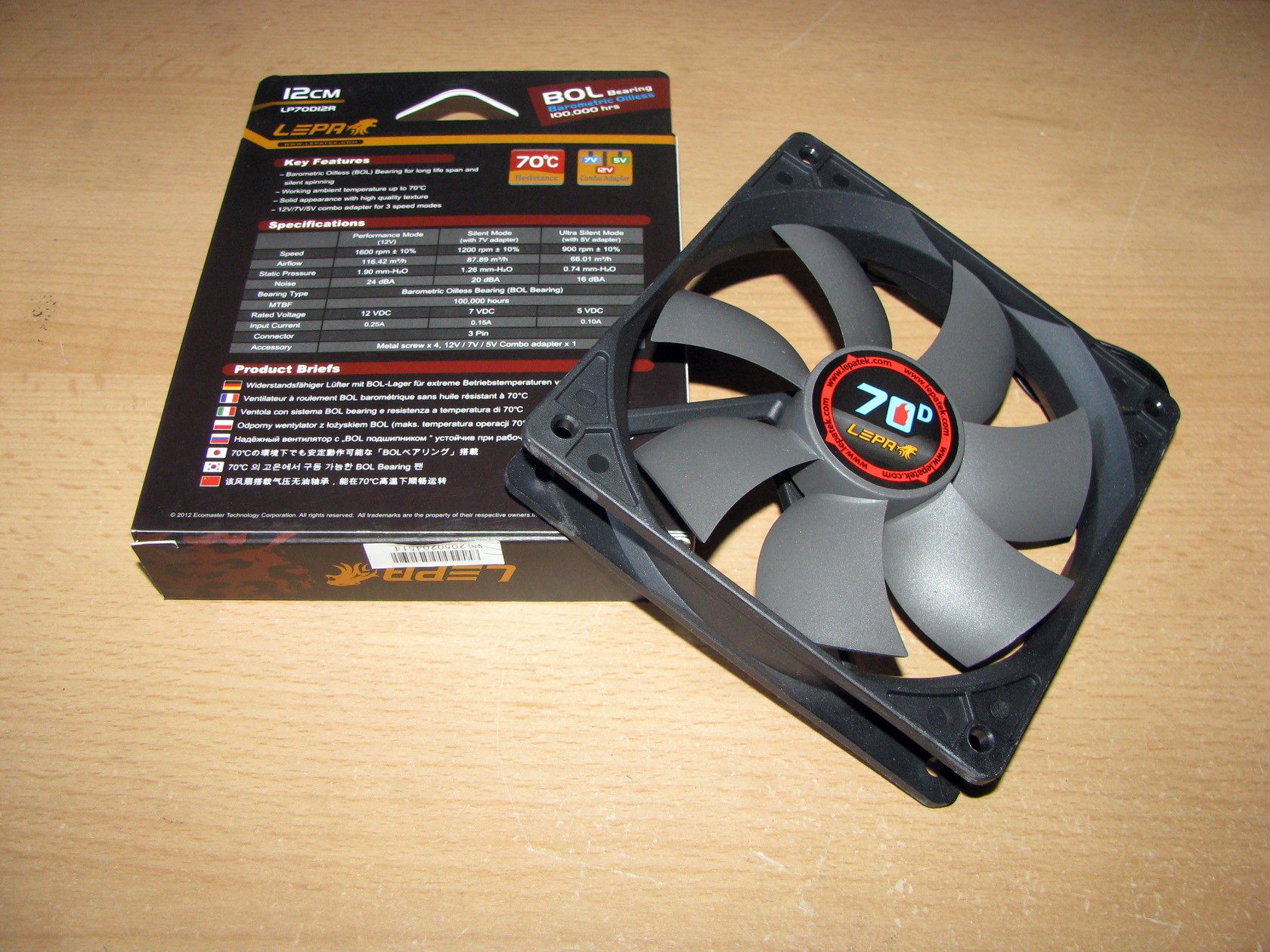
The second competitor in this test and review is actually a model which has almost nothing in common with Vortex, Casino or Chopper series. All models from the other series are made to provide a decent airflow level while working at low noise and including a very nice looking visual effect while this product is offering something different and that is the ability to work at high temperature – ambient temperature up to 70°C for very long time with good airflow and low noise levels.
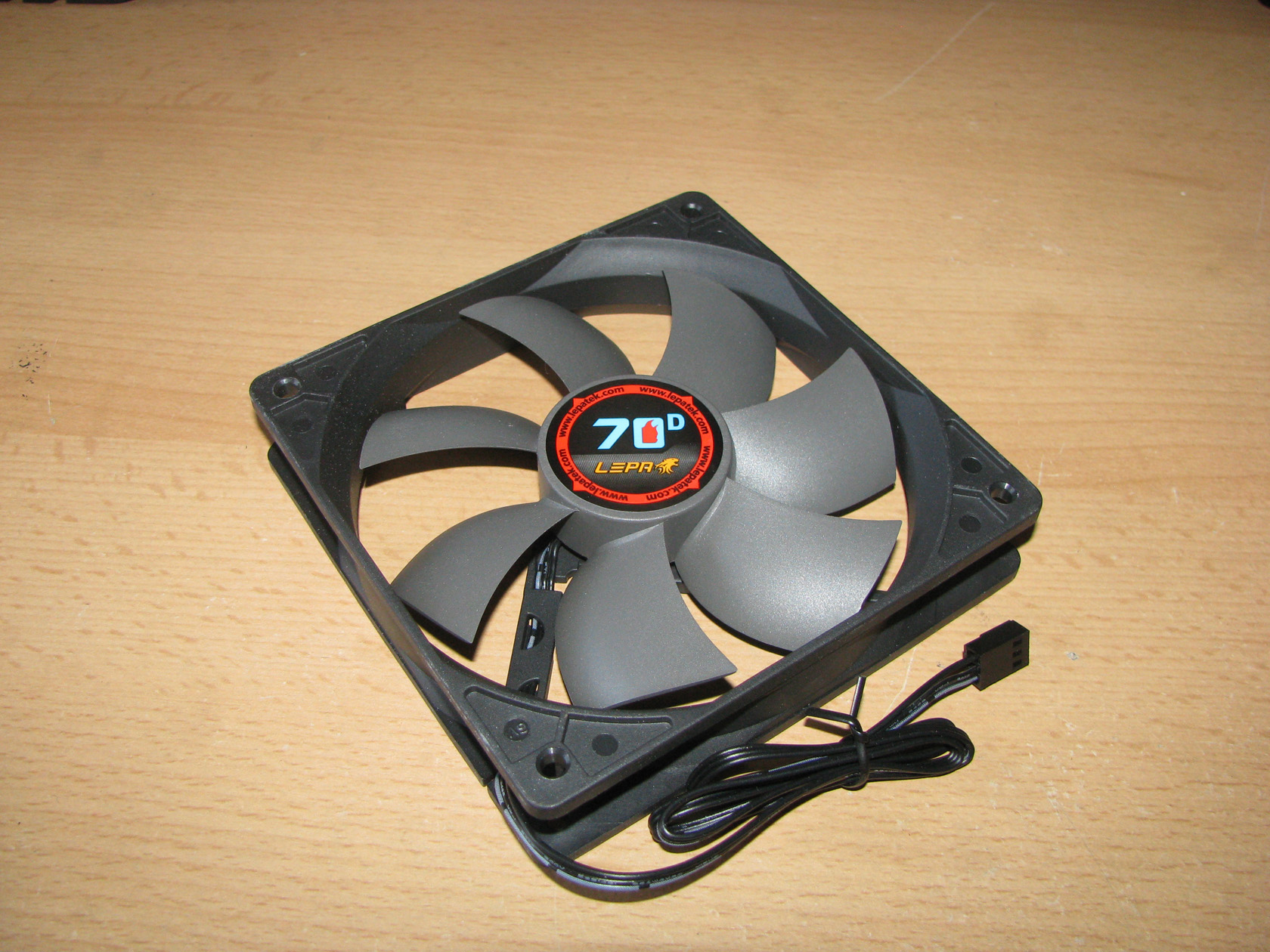
LEPA 70D LP70D12R is made of a bit different plastic than the other models I’ve tested so far and is made with a standard, as a shape square painted in dark grey, or even black frame and a propeller with 7 very wide blades painted in grey with not so sharp an angle. This design is meant to provide good and steady airflow and good static pressure sacrificing a bit the noise level.
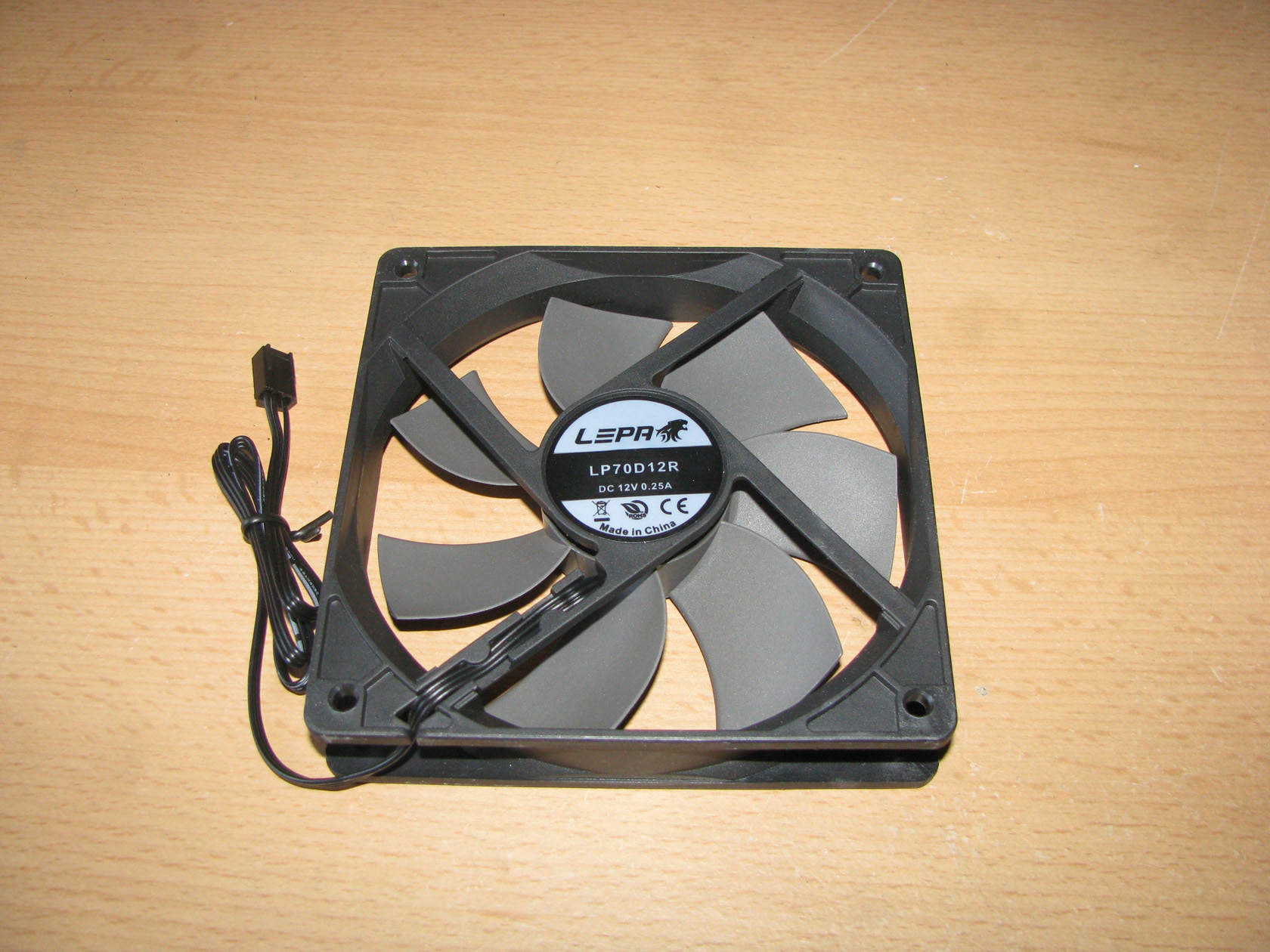
LP70D12R is powered and regulated by a long non-sleeved 3-pin cable and connector painted in black.
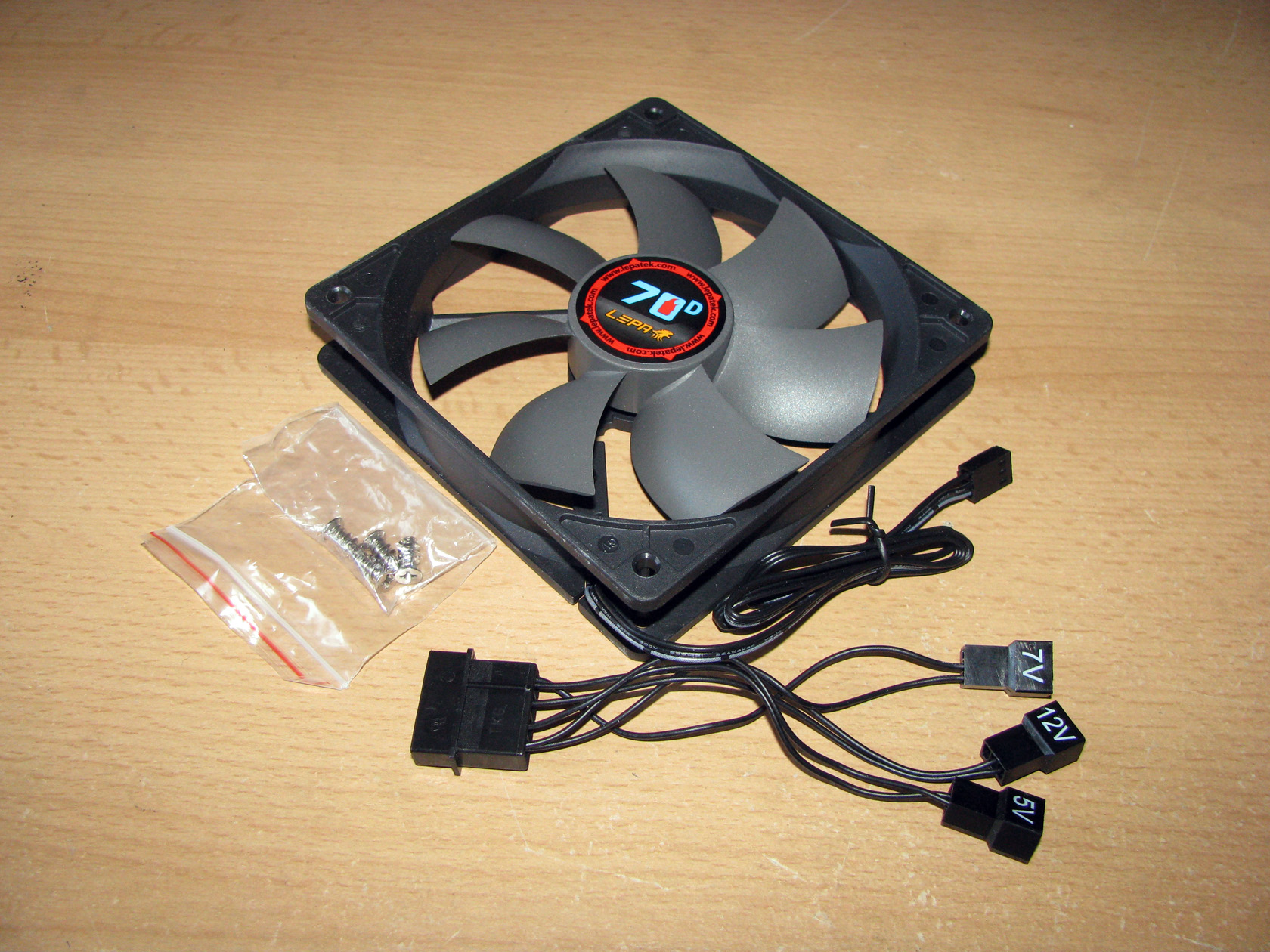
The standard package includes:
- Four screws
- Molex to 12V / 7V / 5V Combo adapter
Actually the additional accessories are not so many but still the combo adapter is a really nice option. Good job LEPA including this very, very useful accessory!
I believe it is time for testing…
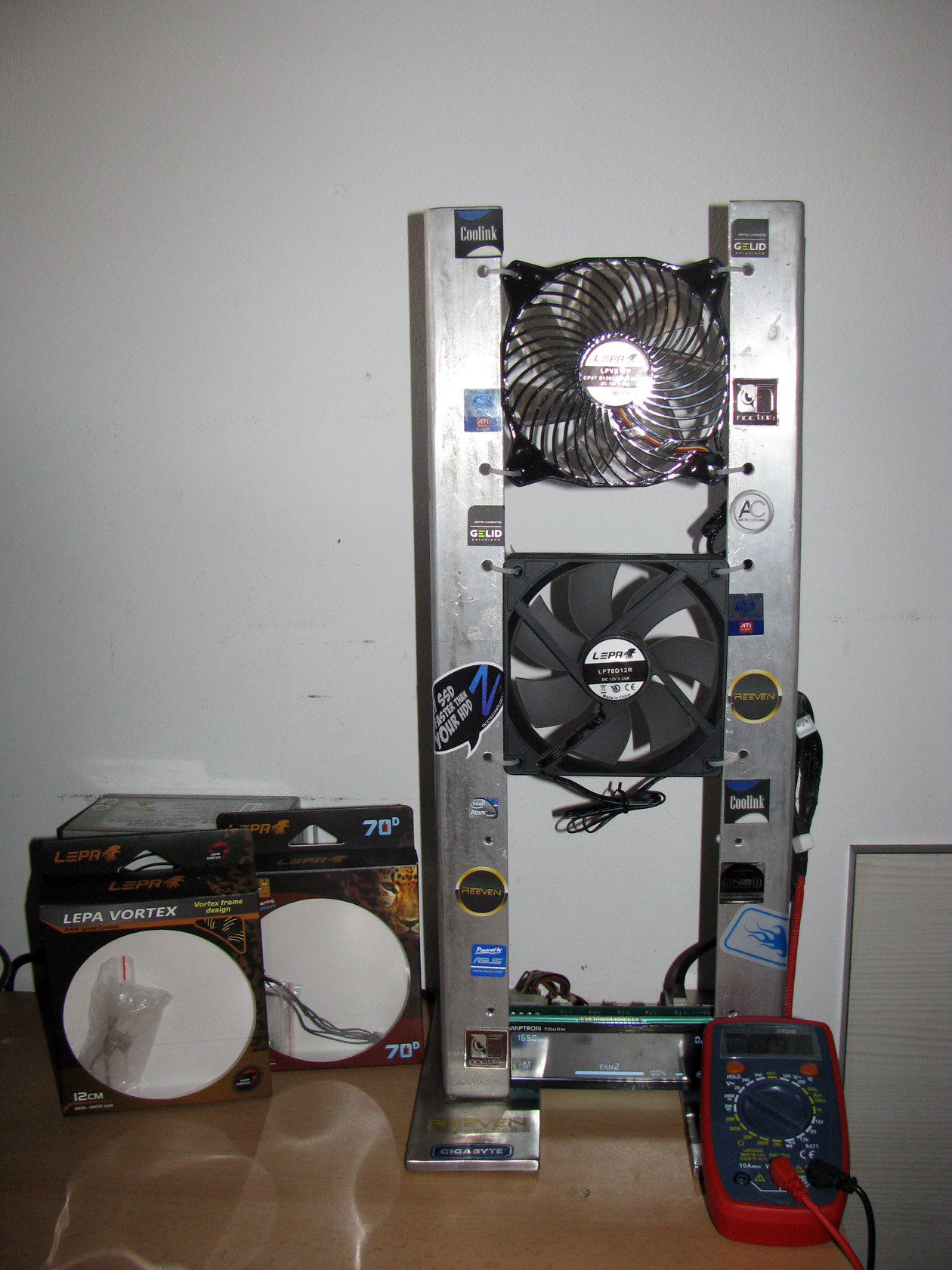
The tests for the test samples will be conducted in my standard way. I will mount both test samples together and test them at 5V/7V/9V/12V and my goal will be to check the performance of the fans in real conditions. The products will be tested under close-to-perfect conditions, not taking into account any external factors. The results achieved during the tests can in no way be the same if the fans are mounted on a cooler or on the case fan hole of any modern computer case. I will measure the amount of air going through the fans for one hour and their speed. For this I use a fan controller, a voltage meter, an anemometer and a stand made specifically for this purpose.
And this is how both of the fans look installed on my test stand:
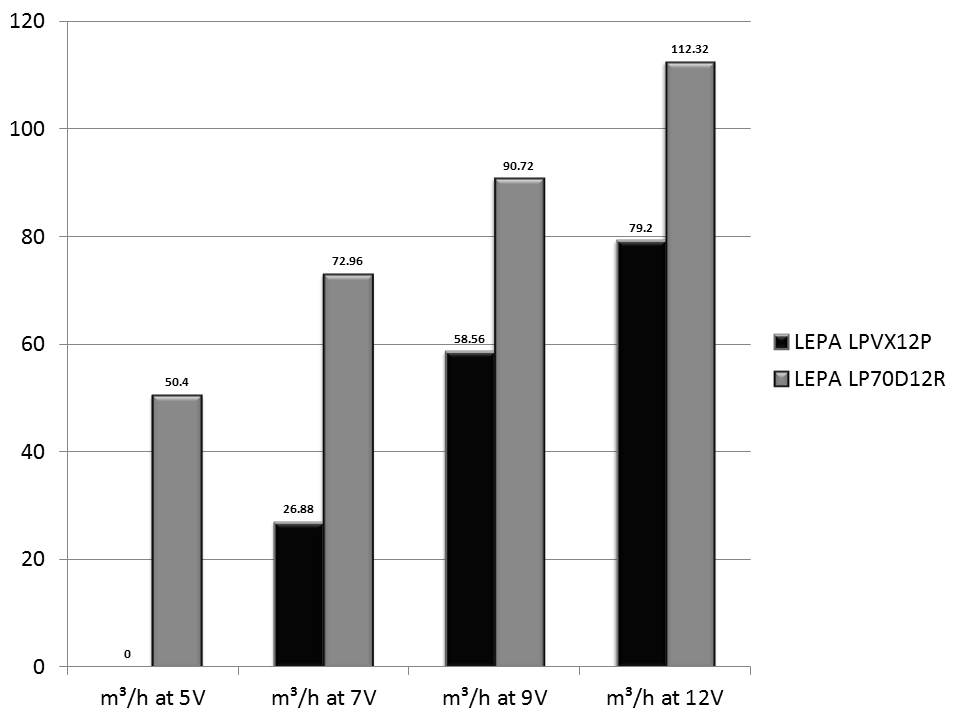
The test results are shown in the following charts:
Airflow through the fans at 5V, 7V, 9V, 12V.
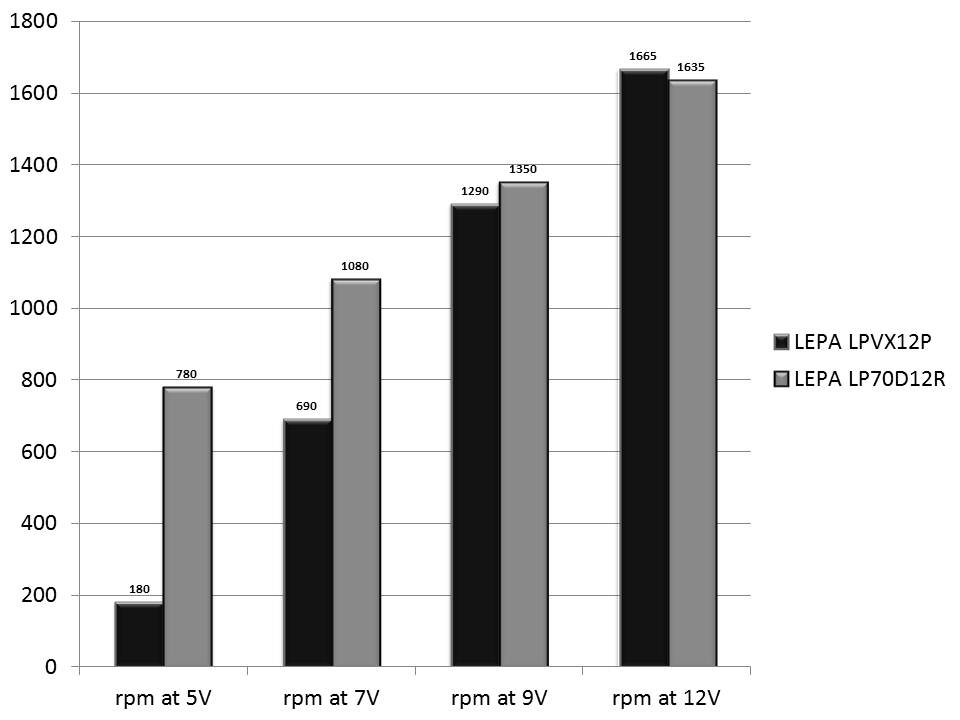
Propellers rpm during the tests at 5V, 7V, 9V, 12V.
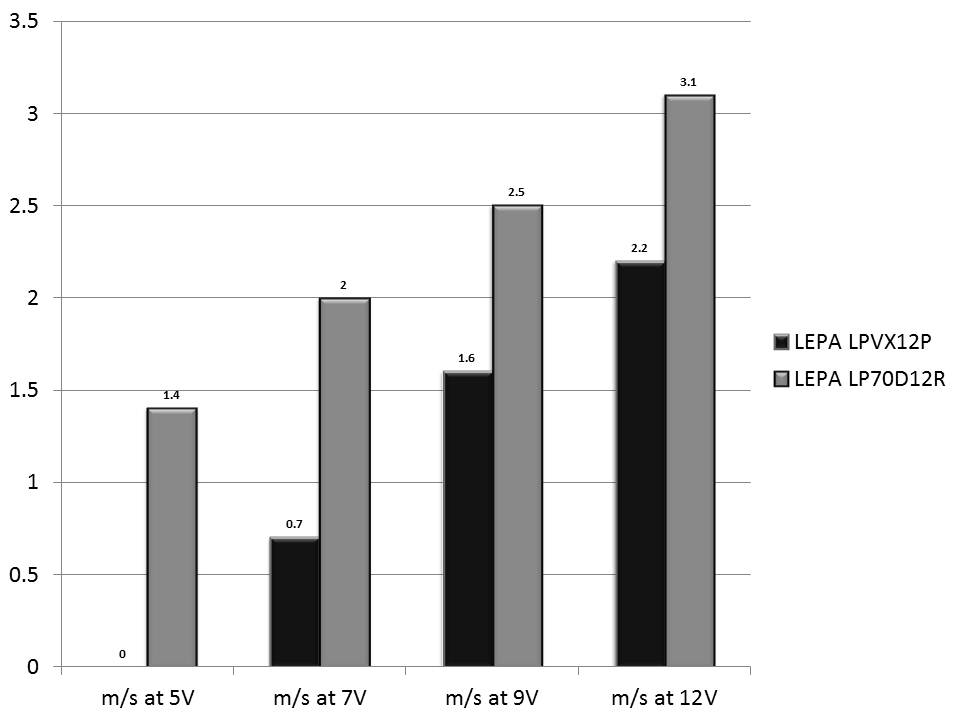
The anemometer showed the following air speed passing through the fans:
After mounting the fans onto the stand and leaving them to run for about 30 minutes at maximum speed, it was time for the tests to begin.
As with my other tests, again I started with a gradual increase of the voltage through the Lamptron FCT starting at 0V and LEPA Vortex LPVX12P did at least one full revolution at 7V and to do the first test I had to decrease the voltage to 5V, while LEPA LP70D12R started rotating at about 3.5V.
Test at 5V:
After I decreased the voltage for LEPA Vortex LPVX12P to 5V the fan was rotating at 180 revolutions per minute but the anemometer couldn’t measure any airflow at all. LEPA LP70D12R didn’t have such a problem and was rotating at 780 revolutions per minute providing airflow level of 50.4 cubic metres per hour. Both of the fans were completely silent.
Test at 7V:
At the second test which was actually the starting voltage for LPVX12P the model was rotating steadily with 690 revolutions per minute and airflow level of 26.88 cubic metres per hour. The second contestant in this article was working at 1080 revolutions per minute with airflow level of 72.96 cubic metres per hour. Again both of the fans were completely silent.
Test at 9V.
The third test conducted at 9V boosted the fans a little and LPVX12P was providing airflow level of 58.56 cubic metres per hour rotating with 1290 revolutions per minute, while LEPA LP70D12R 1350 revolutions per minute with airflow level of 90.72 cubic metres per hour. Both fans started to generate noise from the air passing through the propellers.
Test at 12V.
At the last test both of the models reached their maximum performance which for LEPA LPVX12P was 79.2 cubic metres per hour at 1665 revolutions per minute, while LEPA LP70D12R reached 1635 revolutions per minute and airflow level of 112.32 cubic metres per hour. The noise from both fans increased but they were still rather quiet.
After I finished testing there is something which made me a bit confused. According to the official technical details, LEPA LPVX12P is rated with bigger airflow level than the one I measured, while for LEPA LP70D12R everything was normal. So there are 2 options – the test sample I’ve used may be faulty or the vortex feature is messing the airflow and the anemometer is measuring it wrong. Both are possible but still after a few attempts the results were always the same.
I believe the time to share my conclusions has arrived:
- Performance: To be honest I was expecting a bit more from the LEPA LPVX12P but still obviously the fan is made to be installed on a case fan slot and boost the airflow inside the case. With it’s vortex effect I believe best option for this product is to be installed as intake fan and cool every hardware component on the airflow way. On the other hand, LEPA LP70D12R is the typical fan to be installed on a CPU cooler, meant to cool a processor working at normal, overclocked or extreme overclocked frequency. In any case this fan will guarantee powerful and steady airflow, ressistance to high temperature with long life span and low noise level.
- Noise level: Both of the fans were completely silent while working at 5 and 7V, while both of them started to generate a tiny noise at 9V, which actually increased a bit when the fans were working at maximum 12V.
- Apperance: What can I say… LEPA LPVX12P as the typical case fan is made to look agressive and with this colour scheme to be neutral when installed inside the case, which makes it a perfect choice for every modern or even modded case, while LEPA LP70D12R as the product meant to be the main cooling unit inside the system is a bit simpler and still colour neutral with this black/grey colour scheme.
According to this article I believe that:
LEPA Vortex LPVX12P deserves the following reward:

and LEPA 70D LP70D12R:

LEPA Vortex LPVX12P and LEPA 70D LP70D12R have been added to the 120mm fans catalogue.
Official price (MSRP):
LEPA Vortex LPVX12P – unknown
Warranty: 12 months
LEPA 70D LP70D12R – unknown
Warranty: 12 months
I thank LEPA for the test samples.